
The only remaining photograph of di Gatti taken ca. 1858, 3 years after his first encounter with the Rosenungetüm (what he originally called “Esha Sorti”, or “pink love”). Here he is wearing his ceremonial half-skull mask, which has since become a long standing tradition for PAU members.
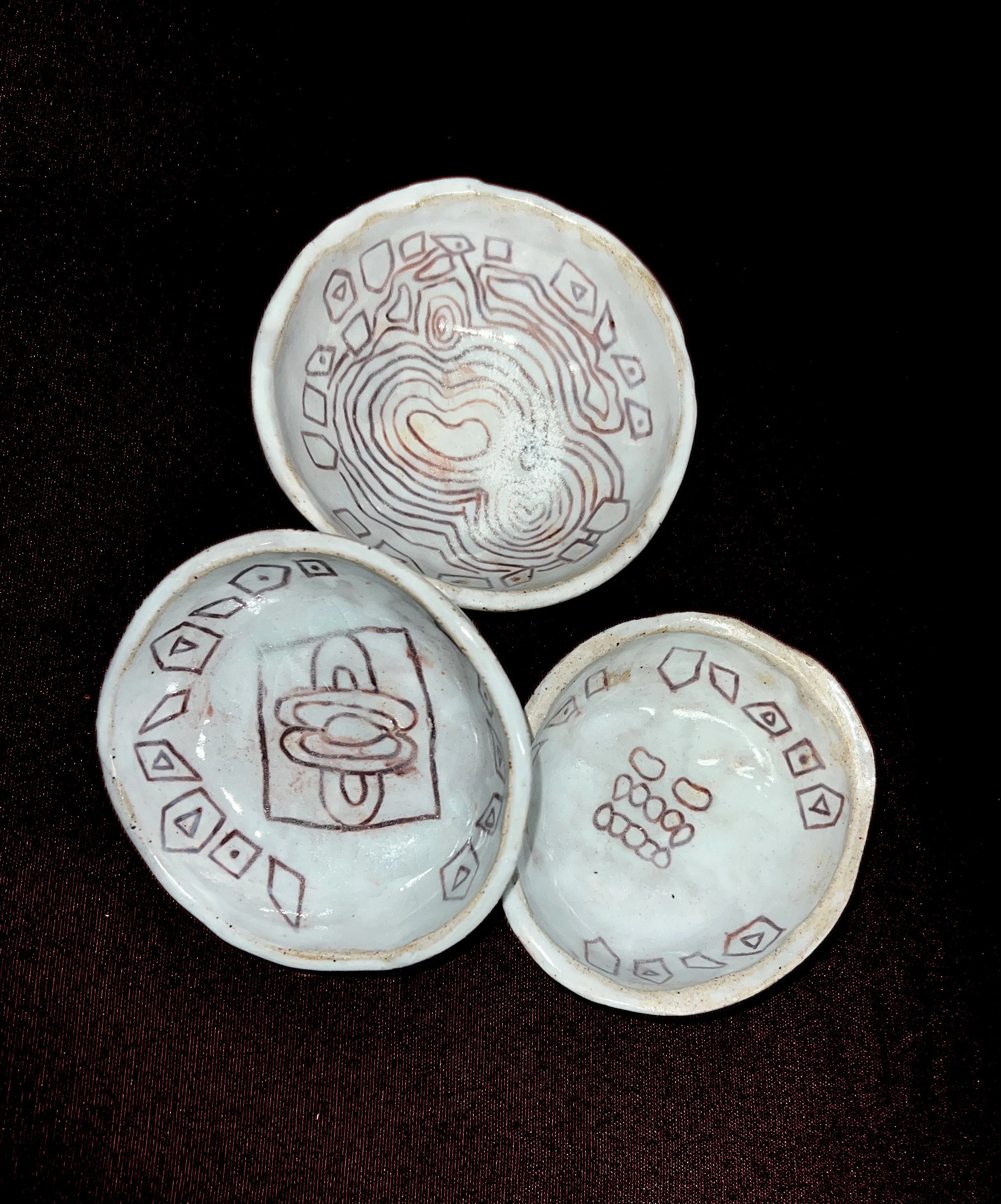
Incantation Bowls, stoneware, 1893-97
In one of his surviving diaries, di Gatti described a close relationship with his grandmother, a woman he only referred to by name once as Shadi. Through piecing together anecdotes described by di Gatti in his papers, our researchers believe that Shadi was a Mandaean, one of the few surviving original Gnostic sects. These incantation bowls are prime evidence for this conclusion, as they are heavily reminiscent of both Mandaean and Jewish incantation bowls created between 200-600 CE. The script around the bowls has yet to be deciphered, but likely is some kind of warding spell or other form of protection.
Marco di Gatti: 1835-1926
Pink Acolyte Service: 1855-1926
Marco di Gatti was the son of Italian immigrants who settled in what is now known as Cincinnati, Ohio. Both foreign to the country and alien to the highly Germanic culture that surrounded them, the di Gatti family worked blue collar jobs around the city. Marco took after his father and older brothers and entered the construction industry as a stone mason, joining the Cincinnati-Lafayette Lodge 483 at the young age of 19.
Most of di Gatti’s surviving vessels were used in various rituals. While the current whereabouts of the Rosa Codex are unknown, many of his elaborate rituals and ceremonies continued to be practiced and documented beyond his death. The majority of his ceramic works are now held at the Luscinia Historical Society and may be viewed and researched there.